There’s a specific kind of tired that regular sleep doesn’t seem to fix – the mental exhaustion that lingers even after eight hours in bed. This is precisely the gap Yoga Nidra was designed to close. Often translated as “yogic sleep,” it’s a guided practice that takes you to the very edge of sleep without letting you fall into it, and in doing so, reaches a state of rest that ordinary sleep and ordinary meditation don’t quite access on their own.
Where Yoga Nidra Actually Comes From
While its roots trace back to ancient tantric practices, the structured form practiced today was systematized in the 1960s and 70s by Swami Satyananda Saraswati of the Bihar School of Yoga, who organized centuries-old techniques into the clear, repeatable protocol still taught worldwide. This matters, because unlike some yoga practices that have drifted from their origins, Yoga Nidra’s modern form is a fairly direct continuation of a deliberately engineered system – one built specifically to guide the mind through distinct stages of withdrawal and rest.
How Yoga Nidra Is Different From Meditation and From Sleep
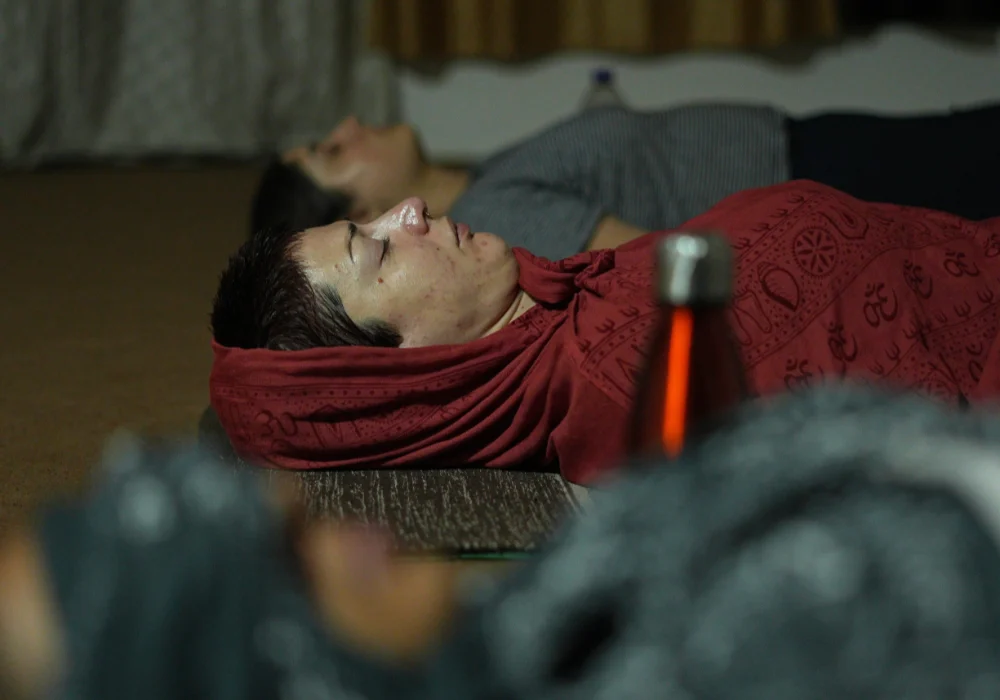
This is the detail most explanations skip past too quickly. Ordinary seated meditation typically keeps the brain in an alert, alpha-wave state. Ordinary sleep moves through deeper theta and delta wave states, but with awareness switched off entirely. Yoga Nidra deliberately positions itself in between the two – practiced lying down, deliberately approaching the threshold of sleep, while a structured verbal protocol keeps a thread of awareness present so you don’t fully drop off.
This is also why it’s practiced lying down rather than seated, unlike almost every other meditative technique – the whole method depends on getting close enough to sleep to access those deeper, more restorative states of the nervous system, while staying just conscious enough to remain aware of the process.
What the Research Actually Shows
Yoga Nidra has attracted a genuinely unusual amount of scientific interest for a practice that, on the surface, just looks like guided relaxation. A few of the more notable findings:
- Sleep quality. Research published in the International Journal of Yoga found meaningful improvements in sleep quality among participants with chronic insomnia after a course of regular Yoga Nidra practice.
- Cognitive performance. A study on novice practitioners found that even short-term Yoga Nidra practice improved reaction times and task accuracy across multiple cognitive measures, alongside better night-time sleep.
- Mood regulation. Recent research using validated mood-state measures found Yoga Nidra produced measurable short-term improvements in mood – though interestingly, the same research suggested the psychological benefit comes from staying in the aware, “hovering” state of the practice, rather than from actually drifting into deeper sleep stages.
- Trauma and PTSD. Studies involving military veterans and trauma survivors have found regular practice associated with reduced PTSD symptoms and improved emotional regulation, likely tied to the practice’s effect on calming an overactive stress response.
- Chronic pain. Yoga Nidra is currently being studied specifically for chronic lower back pain, in combination with pain education, as a non-drug approach to reducing both pain intensity and its emotional weight.
Worth noting: it’s an active, still-developing area of research, more thoroughly studied on the psychological side (mood, stress, sleep quality) than on physiological biomarkers so far – but the existing evidence base is genuinely more substantial than what most casual mindfulness techniques can claim.
The Stages of a Yoga Nidra Practice
A complete session typically moves through a series of distinct stages, each guiding a different layer of relaxation:
Settling in.
You lie down in a comfortable position, becoming aware of the external environment – the sounds in the room, the surface beneath you, the temperature – before gradually turning attention inward.
Setting a Sankalpa.
A short, positive intention or resolve, held silently in mind. This isn’t a wish-list item; it’s meant to be a deeper personal intention that the practice helps plant more firmly in the subconscious.
Body rotation.
The guide systematically names body parts in sequence, and you simply move your awareness to each one without any physical movement – a technique that quickly and efficiently relaxes the entire body from the inside out.
Breath awareness.
Attention shifts to the natural rhythm of the breath, without trying to change or control it in any way.
Opposite sensations.
You’re guided to briefly recall or imagine pairs of contrasting sensations – heat and cold, heaviness and lightness – which helps deepen the state of relaxation and mental flexibility.
Visualization.
A sequence of images or symbolic scenes is offered, engaging a different, more imaginative layer of the mind than the earlier body-based stages.
Returning to the Sankalpa.
The original intention is silently repeated once more, now planted deeper following the relaxation that came before it.
Gradual return.
Awareness slowly comes back to the body and the room, and the practice closes with slow, gentle movement before opening the eyes.
Yoga Nidra and the "NSDR" Trend
If you’ve come across the term NSDR (Non-Sleep Deep Rest), popularized in recent years through neuroscience-focused wellness content, it’s worth knowing where it comes from: NSDR is built directly on Yoga Nidra research, but strips away the traditional framework – the Sankalpa, the visualization, the deeper tantric context – down to its physiological core. Both are genuinely effective for rest and recovery. The difference is that Yoga Nidra offers the fuller, more intentional practice, with layers of purpose beyond simple nervous-system recovery, while NSDR is essentially a modern, secularized subset of the same underlying technique.
How to Actually Start Practicing
Yoga Nidra doesn’t require any physical flexibility or prior meditation experience, which makes it one of the more accessible practices in the entire yoga tradition:
- Lie down in a comfortable position, ideally with a blanket for warmth, since body temperature tends to drop during deep relaxation.
- Use a guided audio recording rather than trying to self-direct the stages, at least at first – the sequencing itself is part of what makes the technique work.
- Practice for 20 to 30 minutes at a time, ideally in a quiet space where you won’t be interrupted.
- Resist the urge to judge whether you “did it right.” Some sessions you’ll stay fully aware throughout; others you may genuinely doze off partway through. Both are normal, and neither means the practice failed.
A Brief Word of Caution
While Yoga Nidra is broadly considered safe and gentle, anyone working through significant trauma should ideally practice with guidance from a trained teacher familiar with trauma-sensitive approaches, since turning inward and relaxing deeply can occasionally bring up unexpected emotional material. This isn’t a reason to avoid the practice – it’s simply a reason to have the right support in place if that’s part of your situation.
Frequently Asked Questions
Is Yoga Nidra the same as meditation?
Not quite. Meditation is typically practiced seated and keeps the brain in a more alert state. Yoga Nidra is practiced lying down and deliberately moves closer to the threshold of sleep, accessing a different, deeper layer of rest through a structured verbal protocol.
Can Yoga Nidra replace actual sleep?
No, though many practitioners describe a single session as feeling remarkably restorative – some research suggests 30 minutes can produce brain-wave patterns similar to early sleep stages. It’s best understood as a powerful complement to sleep, not a substitute for it.
How long should a Yoga Nidra session be?
Most sessions run between 20 and 30 minutes, though shorter 10-minute versions exist for those newer to the practice or short on time.
Is Yoga Nidra scientifically proven?
There’s a genuinely growing body of research supporting benefits for sleep quality, stress, mood, and even PTSD symptoms, making it one of the more evidence-backed relaxation techniques available, though research is still ongoing, particularly on the physiological side.
What's the difference between Yoga Nidra and NSDR?
NSDR (Non-Sleep Deep Rest) is a modern, secularized version built on Yoga Nidra’s research and technique, but without the traditional framework of intention-setting and visualization. Both are effective; Yoga Nidra simply offers a fuller, more traditionally rooted practice.
Learning to Guide Others Through It
Understanding Yoga Nidra deeply enough to actually guide a group through it – pacing the stages correctly, holding the right tone of voice, knowing when to bring people back – is a genuine teaching skill, distinct from simply having experienced it yourself. It’s part of what’s covered in the meditation and pranayama modules of our 200-Hour Yoga Teacher Training in Rishikesh, so graduates leave able to lead this practice with real confidence, not just familiarity.