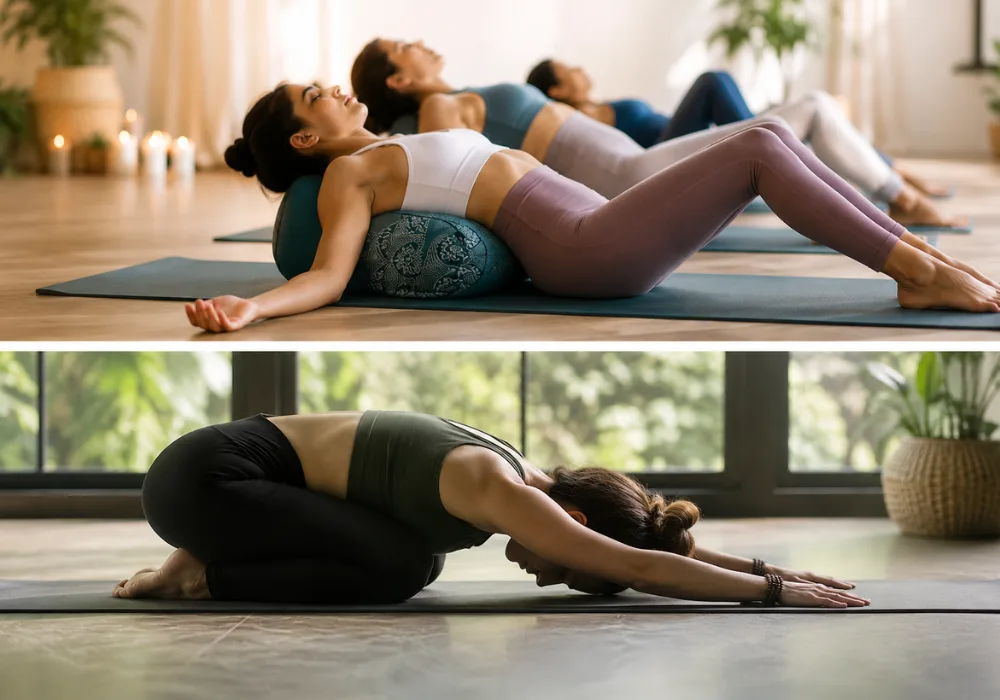
Walk into a Yin class and a Restorative class on the same day, and you might struggle to tell them apart. Both are slow. Both involve long, quiet holds close to the floor. Both feel like a world away from a sweaty vinyasa flow. But underneath that surface similarity, these two practices are built on almost opposite intentions — and picking the wrong one for what your body actually needs can mean walking away from class wondering why it didn’t help the way you expected.
Let’s untangle the two properly.
The Core Difference in One Sentence
Yin yoga asks you to stay with sensation. Restorative yoga removes sensation entirely so you can fully let go.
That single distinction explains almost everything else that follows — how long poses are held, how many props are used, and who each practice actually suits.
What Is Yin Yoga?
Yin yoga targets your connective tissue – the fascia, ligaments, and joint capsules that don’t respond to the quick, dynamic stretching used in most other yoga styles. To reach that deeper tissue, Yin poses are held for three to five minutes, sometimes longer, while the muscles stay soft and passive.
You’re not aiming for your deepest possible stretch. Instead, you settle into what’s often called your “working edge” — a point where you feel a real, sustained sensation, but not pain. Props like blocks or bolsters might be used to help you find or soften that edge, but the sensation itself is the point, not something to be propped away. Over time, this sustained, gentle load encourages the tissue to lengthen and adapt, which is why Yin is closely associated with improved flexibility and joint mobility.
Because you’re deliberately asking the tissue to do something, Yin can bring up real physical sensation, and sometimes emotional response along with it, as your body sits still long enough to notice things it usually moves past.
What Is Restorative Yoga?
Restorative yoga has the opposite goal: complete, effortless rest. Rather than working the tissue, every pose is fully supported by props — bolsters, blankets, blocks, straps, even sandbags — so that no part of the body is bearing any load at all. The muscles are essentially switched off.
Poses are held even longer than in Yin, typically five to twenty minutes, giving the nervous system enough time to fully shift into a parasympathetic, “rest and digest” state. A typical Restorative class might move through only two to four poses in an entire hour, because the point isn’t to do more — it’s to stay in each shape long enough to genuinely unwind.
If a pose doesn’t feel completely comfortable, the answer in Restorative yoga is always more support, not more effort. There should be no stretch sensation at all — just total, cushioned stillness.
Side-by-Side Comparison
Here’s how the two stack up against each other, point by point.
Goal: Yin yoga works to stretch and stimulate the connective tissue. Restorative yoga works toward total nervous-system rest.
Hold time: Yin poses are held for roughly 3 to 5 minutes. Restorative poses are held much longer, anywhere from 5 to 20 minutes.
Sensation: In Yin, you’re meant to feel a real, manageable sensation at your edge. In Restorative, there should be no stretch sensation at all — just full comfort.
Props: In Yin, props are used to support or deepen the stretch. In Restorative, props are used to remove effort completely, cradling the body so nothing is under load.
Best for: Yin suits people looking to improve flexibility and joint mobility, especially tight athletes or anyone who sits most of the day. Restorative suits people dealing with stress, burnout, recovery, or anyone who simply needs deep, effortless rest.
Which One Should You Choose?
Yin yoga, because it deliberately loads the joints and connective tissue, isn’t automatically appropriate for everyone — especially those with existing joint injuries, tissue damage, or difficulty getting up and down from the floor. Restorative yoga’s complete-support approach makes it a gentler, safer starting point for most people recovering from injury or illness, though it’s worth checking with a teacher or your doctor if you have specific concerns either way.
Both Practices, Taught Properly
Understanding when and why to use a slow practice like Yin or Restorative — rather than defaulting to a fast, dynamic class for everyone — is exactly the kind of sequencing knowledge that separates a competent teacher from a truly skilled one. It’s a core part of what we cover in the teaching methodology and sequencing modules of our 200-Hour Yoga Teacher Training in Rishikesh, so you leave able to read what a room actually needs, not just run through a fixed sequence.