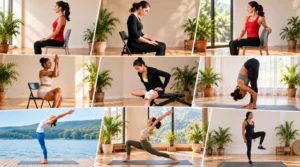

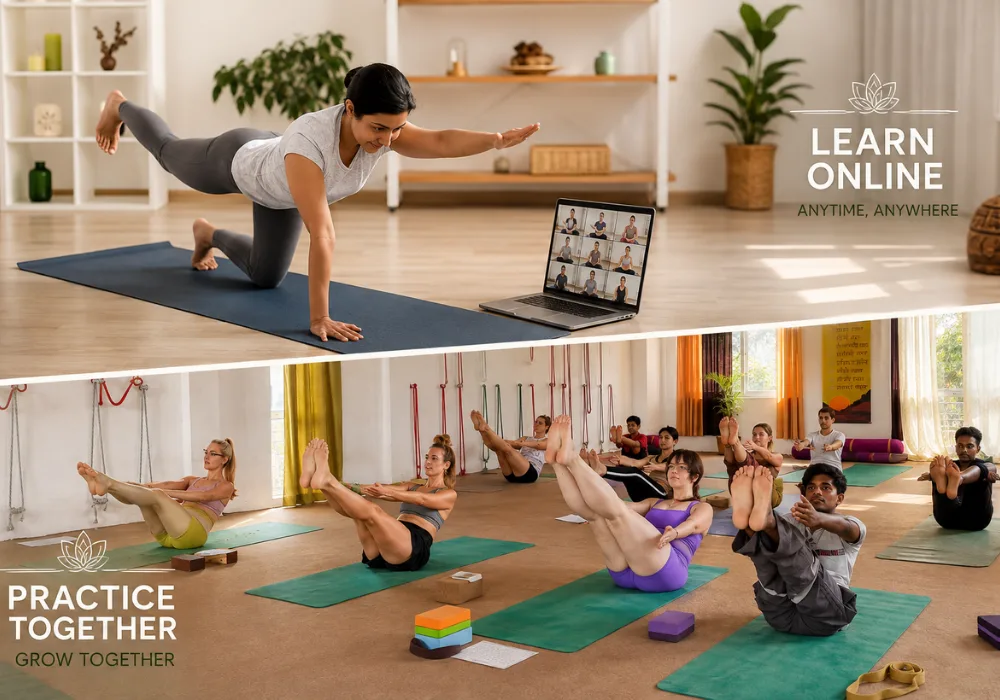
Since 2020, online yoga teacher training has gone from a stopgap to a permanent fixture of the industry. You can now find fully online 200-hour programs, hybrid options that split time between a screen and a studio, and traditional in-person immersions like ours here in Rishikesh. All of them can lead to the same three letters after your name: RYT.
So the real question isn’t “which one is legitimate” – both can be. The real question is: what actually transfers from a laptop, and what doesn’t? Here’s an honest answer, not a sales pitch either way.
First, the Accreditation Question
Yoga Alliance doesn’t grant credibility based on format. What matters is whether the school is an active Registered Yoga School (RYS) and whether the curriculum meets the required hour distribution across contact time, non-contact study, and self-directed learning. An online 200-hour program from an RYS-registered school and an in-person one from an RYS-registered school both make you eligible for RYT registration. Format alone doesn’t decide that.
So if someone tells you “online certifications aren’t real,” that’s outdated. They can be exactly as real, on paper, as an in-person one – provided the school is properly registered. The distinction that actually matters is a different one: what the training actually built in you, not what the certificate says.
What Transfers Well From an Online Format
To be fair to online training, some parts of a YTT curriculum genuinely translate well to video and Zoom:
- Anatomy and physiology – a well-produced video lecture on the muscular and skeletal system works just as well recorded as live.
- Yoga philosophy and history – the Yamas, Niyamas, and classical texts can be taught effectively through reading, discussion, and video lecture.
- Business and teaching methodology – how to structure a class, market yourself, and handle liability can absolutely be learned remotely.
- Self-paced flexibility – for someone with a job, kids, or a tight budget, spreading 200 hours over several months around a screen is sometimes the only realistic option.
If your primary goal is the credential and the theoretical knowledge, and you’re already a confident, experienced practitioner, an online program can genuinely deliver that.
For students looking for a middle ground, hybrid yoga teacher training can combine the flexibility of online study with the practical benefits of an in-person immersion. All Yoga Training, a yoga teacher training provider in Bali, offers a hybrid program that combines online Anatomy and Yoga Philosophy study with a 12-day in-person immersion focused on practical teaching, alignment, cueing, sequencing, and hands-on experience.
What Doesn't Transfer — and Why It Matters
Here’s where the honesty has to come in, because this is the part most program marketing glosses over.
Hands-on alignment correction. A teacher physically adjusting your hips in Warrior II, or catching a subtle knee misalignment in Tree Pose before it becomes a chronic injury pattern, cannot happen through a webcam. You can be told what correct alignment looks like online. You can only feel it corrected in person.
Learning to read a room. Teaching yoga isn’t just knowing a sequence – it’s reading fifteen different bodies in a room and adjusting your cues in real time. This is a skill built entirely through repetition of live teaching practice, in front of real people, receiving real feedback. A recorded practice-teach submitted for review is a poor substitute for a teacher watching you live and saying “stop, come back to that cue, say it differently.”
Immersion and daily discipline. A huge part of what changes people during a 200-hour YTT isn’t the curriculum – it’s living the lifestyle for 3-4 weeks straight. Daily 6am pranayama, communal satvik meals, no phone during practice, a community of strangers becoming close friends under shared physical and mental effort. None of that exists in a program you complete from your own living room between other responsibilities.
Direct mentorship. In an immersive program, your teacher watches you every single day. They notice when your practice is off because you didn’t sleep well, or when your ego is getting in the way of a pose. That kind of ongoing, contextual mentorship is very difficult to replicate through scheduled video calls.
The Ayurveda and lifestyle component. Concepts like dosha balancing, sattvic eating, and daily routine (dinacharya) are genuinely difficult to absorb in the abstract. Living them for a month – eating the food, following the rhythm, feeling the difference in your own body – teaches something a slideshow cannot.
Who Should Actually Consider Online
To be fair, online isn’t automatically the “lesser” choice for everyone:
- An experienced practitioner mainly seeking the credential to teach at their existing studio
- Someone with genuine scheduling or financial constraints that make a multi-week trip impossible right now
- Someone using an online 300-hour program to add hours on top of an in-person 200-hour foundation they already completed
- If that sounds like you, take a closer look at our 200-hour online program — live classes with real instructor feedback, without the travel.
Who Should Prioritize In-Person
- Anyone who is relatively new to yoga and needs hands-on correction to build safe habits
- Anyone whose real goal is to teach, not just get certified – because teaching is a physical, in-the-room skill
- Anyone who wants the personal transformation that comes from stepping away from daily life, not just the theoretical knowledge
- Anyone planning to teach in a studio or retreat setting where in-person training carries more weight with employers and students
The Honest Bottom Line
An online YTT can check the accreditation box. What it generally can’t do is replace the hands-on correction, live teaching practice, and immersive discipline that make someone a genuinely confident, safe teacher – not just a certified one.
If your goal is a piece of paper, online can get you there. If your goal is to walk away actually capable of holding space for a room full of strangers and adjusting them safely, that’s still something built far more reliably in person, over weeks of direct practice, than through a screen.
That’s the whole philosophy behind how we run our 200-Hour Yoga Teacher Training in Rishikesh – small groups, daily hands-on correction, and real practice teaching in front of real people, in the birthplace of yoga itself.