Meditation has moved far beyond incense-filled rooms and cross-legged monks on mountaintops. Today it’s backed by neuroscience, taught in hospitals, and practiced by everyone from software engineers to Olympic athletes. But walk into that world for the first time and you’ll hit a wall of names — mindfulness, mantra, Vipassana, Zazen, body scan, TM — with no clear map of what any of them actually mean or how to start.
This guide is that map. We’ll walk through the major techniques in meditation, where they come from, how to actually practice each one, and how to figure out which one fits you — including a close look at the meditation techniques in yoga and meditation techniques in Buddhism that most modern practices are quietly built on.
What Is Meditation, Really?
At its core, meditation is a deliberate training of attention. Every technique — no matter what tradition it comes from — does one of three things:
- Focuses attention on a single point (breath, a word, a flame, a sensation)
- Opens attention to whatever arises, without grabbing onto it (mindfulness, open awareness)
- Transcends effort altogether, letting the mind settle into stillness on its own (as in Transcendental Meditation and some yogic mantra practices)
Almost every named technique you’ll come across is a variation on one of these three mechanisms. Once you see that pattern, the huge list of “types” of meditation stops feeling overwhelming and starts feeling like a menu.
Core Techniques in Meditation (The Complete List)
Mindfulness Meditation
The most researched and most widely taught technique in the West. You sit comfortably, bring attention to the breath, and when the mind wanders — which it will, constantly — you simply notice and return, without judging yourself for drifting.
How to practice: Sit upright, eyes closed or softly lowered. Breathe naturally. Label distractions gently (“thinking,” “planning”) and come back to the breath. Start with 5–10 minutes.
Breath Awareness (Anapanasati)
A more focused cousin of mindfulness, where the breath itself — not the wandering mind — is the entire object of meditation. This is one of the oldest recorded techniques, described in early Buddhist texts, and forms the foundation of most yogic pranayama-linked meditations too.
Body Scan Meditation
You move attention slowly through the body, from feet to head (or vice versa), noticing sensations without trying to change them. Excellent for people who find sitting with a “blank mind” difficult, since there’s always something concrete to focus on.
Loving-Kindness Meditation (Metta)
Originating in Buddhist practice, this technique involves silently directing phrases of goodwill — “may I be happy, may I be at peace” — first toward yourself, then a loved one, a neutral person, a difficult person, and eventually all beings. Research links it to measurable increases in positive emotion and reduced self-criticism.
Mantra Meditation
A word, sound, or phrase (a mantra) is repeated silently or aloud to anchor the mind. This spans traditions — from the Sanskrit “Om” in yogic practice to Transcendental Meditation’s personalized mantras to the repeated Jesus Prayer in Christian contemplative practice.
Transcendental Meditation (TM)
A specific, trademarked mantra-based technique practiced for 15–20 minutes twice daily, sitting with eyes closed. Unlike mindfulness, TM doesn’t ask you to “watch” your thoughts — you simply let the mantra do its work and allow the mind to settle naturally.
Zazen (Zen Buddhist Sitting Meditation)
The seated meditation at the heart of Zen Buddhism. Practiced with a straight spine, lowered gaze, and hands in a specific mudra, with attention resting on the breath until the mind naturally quiets. Often done facing a wall, in set time blocks marked by a bell.
Vipassana (Insight Meditation)
One of the oldest Buddhist techniques, aimed at seeing reality “as it is” rather than through habitual reactions. Traditionally taught in intensive silent retreats (often 10 days), it combines breath focus with systematic body-sensation observation.
Chakra Meditation
Rooted in the yogic energy-body model, this technique involves visualizing and focusing attention on the body’s seven energy centers (chakras), often paired with specific mantras or colors associated with each one, to release blocked energy and restore balance.
Trataka (Candle-Gazing Meditation)
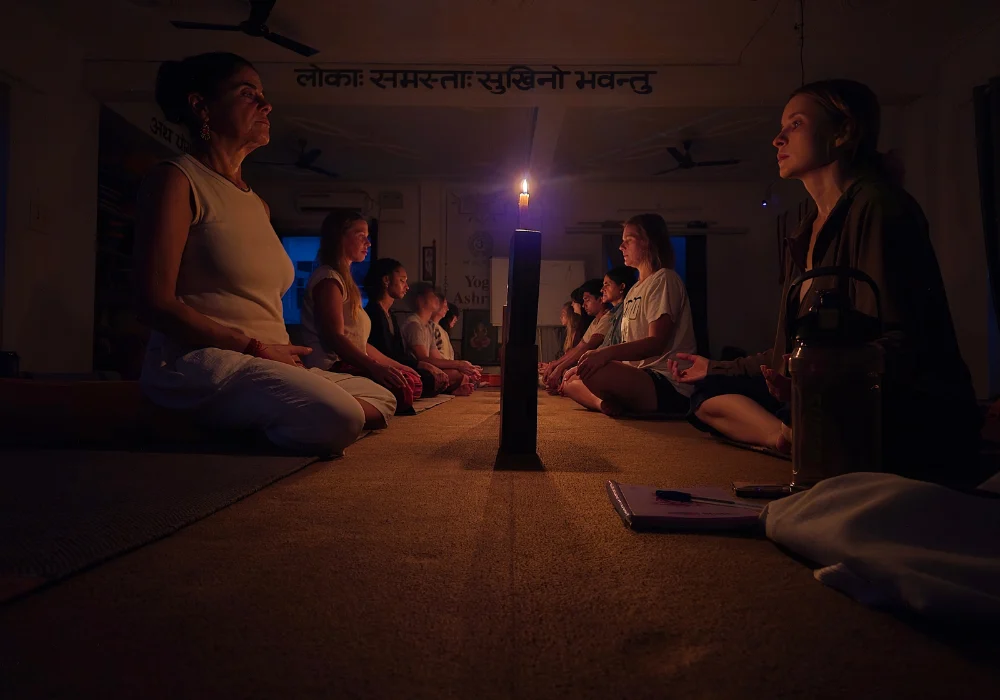
A classical yogic technique where you fix your gaze on a steady point — traditionally a candle flame — until the eyes tear up, then close them and hold the afterimage in the mind’s eye. Used in yogic tradition both for concentration and as a cleansing (shatkarma) practice.
Yoga Nidra (“Yogic Sleep”)
A guided, lying-down meditation that moves the practitioner through stages of deep relaxation while remaining conscious — a state between waking and sleep. Widely used for stress relief, and increasingly studied for its effects on anxiety and sleep quality.
Walking Meditation
Meditation in motion — deliberately slow, attentive walking, with awareness placed on the sensation of each step. A core Buddhist practice, and a good entry point for people who find stillness difficult.
Guided Meditation
Any of the above techniques led verbally by a teacher or recording, talking you through the process step by step. Often the easiest starting point for complete beginners.
Progressive Relaxation
A body-based technique where you systematically tense and then release each muscle group, or visualize tension draining away, working from the feet upward. Frequently used for sleep and physical stress relief.
Visualization Meditation
Using mental imagery — a peaceful place, a healing light, a specific goal — to shift emotional or mental state. Common across both modern secular meditation apps and older tantric and yogic visualization practices.
Meditation Techniques in Buddhism
Buddhism didn’t just influence meditation practice in the West — it’s the direct source of several of the techniques above. Three deserve special mention:
- Anapanasati (breath mindfulness) — the foundational practice described in the earliest Buddhist texts, focused purely on the sensation of breathing.
- Vipassana (insight meditation) — moving beyond calm into direct observation of impermanence and the true nature of experience, traditionally taught in intensive retreat settings.
- Metta Bhavana (loving-kindness cultivation) — systematically extending goodwill outward, from self to all beings.
What distinguishes the Buddhist approach from many Western adaptations is the underlying goal: these techniques aren’t primarily stress-relief tools (though that’s a welcome side effect) — they’re methods for seeing the mind clearly and reducing suffering at its root.
Meditation Techniques in Yoga
In the yogic tradition — the tradition this school is built on — meditation (dhyana) is the seventh of the eight limbs of yoga (Ashtanga), meant to follow naturally after physical postures (asana) and breath control (pranayama) have settled the body and mind. Meditation techniques rooted specifically in yoga include:
- Trataka (candle-gazing) for concentration
- Chakra meditation for working with the subtle energy body
- Mantra japa (repetition of Om or other Sanskrit mantras)
- Yoga Nidra for deep, conscious relaxation
- Dhyana on the breath, following pranayama practice
This is exactly why yogic meditation training tends to be taught alongside asana and pranayama rather than in isolation — in the tradition, they were never meant to be separated.
What Is the Best Meditation Technique in the World?
Short answer: there isn’t a single universal “best” — and any source claiming otherwise is oversimplifying. Research consistently shows that the most effective technique is the one you’ll actually practice consistently. That said, a few patterns are worth knowing:
- Mindfulness meditation has the largest body of clinical research behind it for anxiety and stress reduction.
- Transcendental Meditation has strong evidence specifically for lowering blood pressure and physiological stress markers.
- Loving-kindness meditation shows the strongest effects on positive emotion and reduced self-criticism.
- Yoga Nidra is particularly well-studied for sleep quality.
Rather than chasing “the best,” the more useful question is: best for what? Someone managing anxiety, someone trying to sleep, and someone seeking spiritual depth will likely land on three different answers.
How to Choose the Right Technique for You
- New to meditation? Start with guided mindfulness or breath awareness — low barrier, immediate structure.
- Struggle to sit still? Try walking meditation or a body scan.
- Dealing with anxiety or racing thoughts? Mantra meditation or TM gives the mind something concrete to hold onto.
- Looking for spiritual depth, not just relaxation? Explore Vipassana or yogic dhyana practices with proper guidance.
- Trouble sleeping? Yoga Nidra or progressive relaxation, practiced lying down.
Tips for Building a Real Practice
- Start with 5–10 minutes daily rather than 30 minutes sporadically — consistency beats duration.
- Meditate at the same time each day to build the habit loop.
- Expect a wandering mind — that’s not failure, it’s the practice itself.
- Sit before you eat a heavy meal, not after.
- If a technique doesn’t click after a few honest attempts, try a different one before giving up on meditation altogether.
Frequently Asked Questions
What are the main types of meditation techniques?
The major categories are focused-attention techniques (breath, mantra, candle-gazing), open-monitoring techniques (mindfulness), body-based techniques (body scan, Yoga Nidra, progressive relaxation), and heart-centered techniques (loving-kindness). Most named practices are a variation on one of these.
Which meditation technique is best for beginners?
Guided mindfulness or simple breath awareness. Both have a clear point of focus and don’t require memorizing a mantra or sequence.
Is meditation part of yoga or separate from it?
In the traditional yogic system, meditation (dhyana) is one of the eight limbs of yoga, meant to be practiced after asana and pranayama, not as a completely separate discipline.
How is Buddhist meditation different from yogic meditation?
Buddhist techniques (Vipassana, Metta, Zazen) generally aim at insight into the nature of mind and reduction of suffering. Yogic techniques (trataka, chakra meditation, mantra japa) are traditionally built to follow physical and breath practice as part of a complete eight-limbed path. In practice, the two traditions overlap heavily and have influenced each other for centuries.
Can meditation techniques help with workplace stress or anxiety in public places?
Yes — shorter, portable techniques like breath awareness, a 3-minute body scan, or a single mantra repeated silently work well in offices, commutes, or crowded places, since they don’t require lying down or long silence. (We’re covering these short, situational techniques in dedicated posts — link once published.)
How long does it take to see benefits from meditation?
Some effects (lower heart rate, calmer breathing) show up within a single session. Measurable changes in stress and mood typically take a few weeks of regular practice; deeper changes described in traditional yogic and Buddhist texts are described as a lifelong path, not a quick fix.
Ready to Take Your Practice Further?
Reading about meditation techniques is a good start — but nothing replaces learning them in person, from teachers trained in an unbroken yogic tradition, in the place where these practices originated.
At Rishikesh Yoga Valley, meditation isn’t a bolt-on add-on — it’s woven daily into both our Yoga Teacher Training courses and our dedicated Meditation Retreat in Rishikesh, taught beside the Ganga in the Himalayan foothills.