Yoga vs Meditation: Understanding the Real Difference and How They Complement Each Other
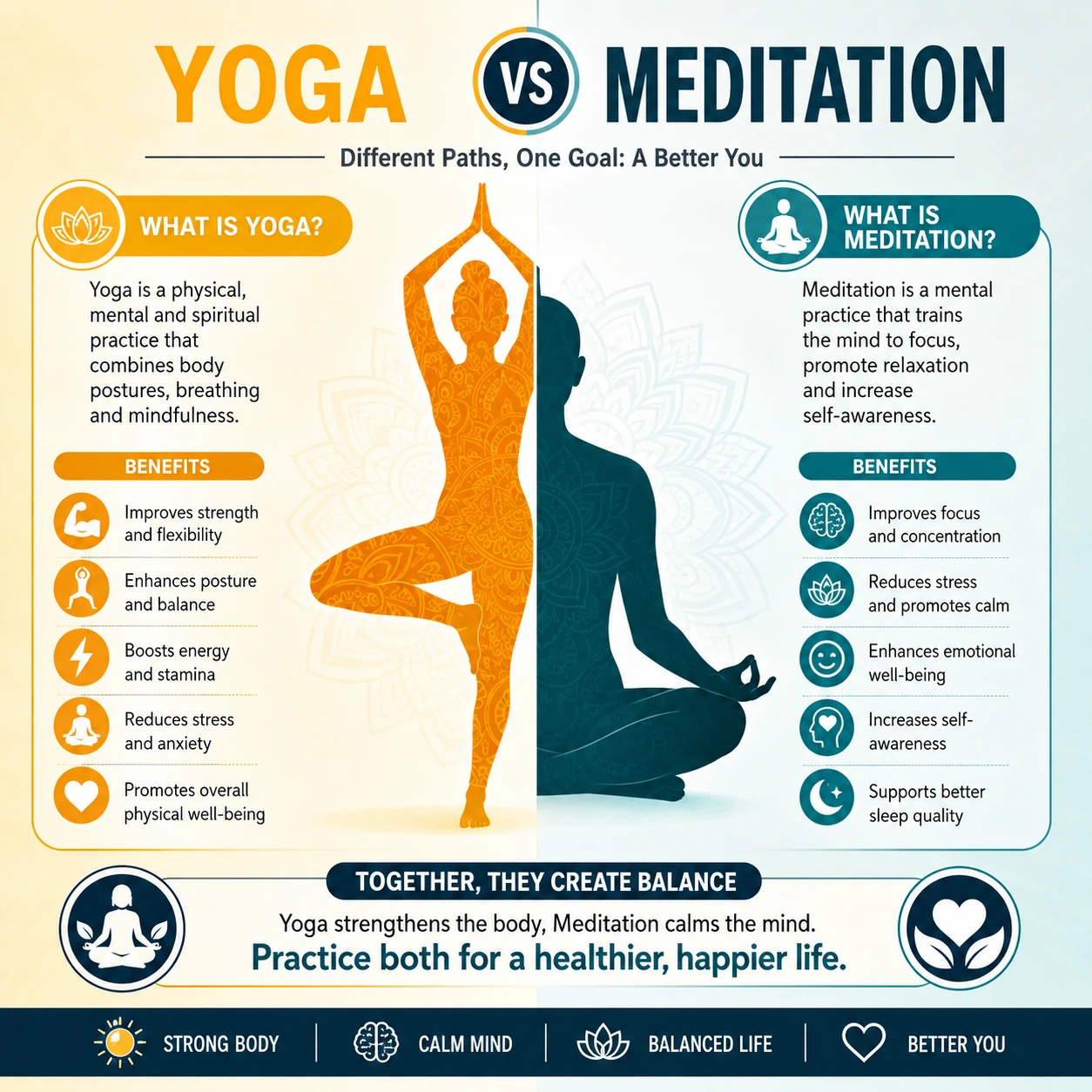
Yoga and meditation are often spoken about as if they are the same practice. Many people assume meditation is simply another form of yoga, while others believe yoga is only physical exercise. In reality, both practices are deeply connected — yet they serve different purposes.
Yoga is a complete system for balancing the body, mind, emotions, and consciousness. Meditation is one important part within that larger yogic framework. Together, they create a powerful path toward inner peace, mental clarity, emotional stability, and overall well-being.
Understanding the difference between yoga and meditation helps beginners choose the right practice for their needs while also showing how both can work together for deeper transformation.
What Is Yoga?
Yoga is an ancient holistic practice that originated in India thousands of years ago. The word Yoga comes from the Sanskrit root Yuj, which means “to unite” or “to join.”
In simple terms, yoga aims to create harmony between:
- The body
- The mind
- The breath
- The emotions
- The spiritual self
Contrary to popular belief, yoga is not just stretching or difficult poses. Physical postures are only one small part of the larger yogic system.
Traditional yoga includes:
- Ethical principles
- Breath control
- Physical postures
- Concentration
- Meditation
- Spiritual awareness
The ultimate goal of yoga is inner balance and self-realization.
What Is Meditation?
Meditation is a mental and awareness practice that trains the mind to become calm, focused, and present.
Unlike yoga postures, meditation usually involves stillness rather than movement. During meditation, attention is directed toward:
- The breath
- A mantra
- A sound
- Bodily sensations
- Thoughts
- Awareness itself
The purpose of meditation is not to “stop thinking completely.” Instead, it helps create awareness of thoughts without becoming controlled by them.
Over time, meditation may help improve:
- Mental clarity
- Emotional balance
- Focus
- Stress management
- Self-awareness
- Inner peace
Meditation is traditionally considered one limb of yoga.
The Main Difference Between Yoga and Meditation
The simplest difference is this:
- Yoga primarily involves movement and body awareness
- Meditation primarily involves mental stillness and awareness
However, the relationship is deeper than that.
Yoga prepares the body and nervous system for meditation. Meditation deepens the inner awareness cultivated through yoga.
Here’s what this means in simple terms:
Yoga helps remove physical restlessness. Meditation helps remove mental restlessness.
Quick Comparison: Yoga vs Meditation
| Yoga | Meditation |
|---|---|
| Involves physical movement | Usually practiced in stillness |
| Focuses on body, breath, and mind | Focuses mainly on awareness and concentration |
| Improves flexibility and strength | Improves mental clarity and emotional calm |
| Uses postures and breathing techniques | Uses mindfulness, breath, or concentration |
| Can be physically intense | Usually physically gentle |
| Prepares the body for meditation | Deepens mental and spiritual awareness |
The 7 Main Types of Yoga
Many people think yoga is one single practice, but there are several styles of yoga. Each focuses on different goals and experiences.
1. Hatha Yoga
Hatha Yoga is one of the most traditional and beginner-friendly forms of yoga.
It focuses on:
- Basic postures
- Gentle breathing
- Relaxation
- Slow movement
Hatha yoga is ideal for beginners who want to build body awareness and learn foundational poses.
Best For:
- Beginners
- Stress reduction
- Flexibility
- Gentle movement
2. Vinyasa Yoga
Vinyasa Yoga links breath with movement in a flowing sequence.
Classes are usually dynamic and energetic, moving continuously from one pose to another.
Benefits:
- Improves cardiovascular fitness
- Builds strength
- Enhances coordination
- Increases flexibility
Best For:
- People who enjoy movement
- Intermediate practitioners
- Energy building
3. Restorative Yoga
Restorative Yoga focuses on deep relaxation and nervous system recovery.
Poses are held for longer periods using props like:
- Bolsters
- Blankets
- Blocks
This style encourages complete physical and emotional relaxation.
Benefits:
- Reduces stress
- Supports healing
- Improves sleep
- Calms the nervous system
Best For:
- Burnout recovery
- Anxiety management
- Deep relaxation
4. Ashtanga Yoga
Ashtanga Yoga follows a structured sequence of physically demanding poses.
It combines:
- Strength
- Discipline
- Breath synchronization
- Continuous movement
Ashtanga is more rigorous than many other yoga styles.
Benefits:
- Builds stamina
- Improves discipline
- Increases flexibility and strength
Best For:
- Experienced practitioners
- Athletic individuals
- Structured routines
5. Kundalini Yoga
Kundalini Yoga combines movement, breathwork, chanting, meditation, and spiritual practices.
The goal is to awaken dormant spiritual energy within the body.
Practices may include:
- Repetitive movements
- Mantras
- Breath exercises
- Meditation
Benefits:
- Emotional release
- Increased awareness
- Spiritual exploration
- Energy activation
Best For:
- Spiritual seekers
- Emotional healing
- Inner transformation
6. Bikram Yoga
Bikram Yoga is practiced in a heated room and follows a fixed sequence of 26 postures.
The heated environment increases sweating and flexibility.
Benefits:
- Detoxification through sweat
- Improved endurance
- Enhanced flexibility
Best For:
- People who enjoy intense workouts
- Heat-based training
- Physical stamina building
7. Yin Yoga
Yin Yoga is a slow-paced practice where poses are held for extended periods.
Instead of targeting muscles, Yin Yoga works deeply into:
- Connective tissues
- Joints
- Fascia
Benefits:
- Deep flexibility
- Joint mobility
- Nervous system relaxation
- Mindfulness
Best For:
- Stress relief
- Deep stretching
- Meditation preparation
How Meditation Fits Into Yoga
In traditional yogic philosophy, meditation is not separate from yoga — it is actually a higher stage within yoga itself.
According to the Eight Limbs of Yoga described by Patanjali:
- Yama (ethical principles)
- Niyama (personal discipline)
- Asana (physical posture)
- Pranayama (breath control)
- Pratyahara (withdrawal of senses)
- Dharana (concentration)
- Dhyana (meditation)
- Samadhi (deep spiritual absorption)
This means meditation is considered an advanced stage that develops after the body and mind become more balanced.
Benefits of Yoga
Yoga offers both physical and mental benefits.
Physical Benefits of Yoga
- Improves flexibility
- Builds strength
- Enhances posture
- Supports joint health
- Improves balance
- Boosts circulation
- Increases energy levels
Mental and Emotional Benefits of Yoga
- Reduces stress
- Improves emotional balance
- Helps manage anxiety
- Supports better sleep
- Encourages mindfulness
- Enhances body awareness
Benefits of Meditation
Meditation primarily supports mental and emotional well-being.
Mental Benefits
- Improves focus
- Enhances concentration
- Reduces overthinking
- Promotes clarity
- Supports emotional regulation
Emotional Benefits
- Reduces stress and anxiety
- Encourages inner calm
- Improves self-awareness
- Supports emotional healing
- Helps create emotional resilience
Can Yoga Replace Meditation?
Yoga can create meditative states, especially during slow and mindful practices. However, yoga and meditation still train different aspects of human experience.
Yoga primarily works through:
- Movement
- Breath
- Body awareness
Meditation primarily works through:
- Stillness
- Observation
- Awareness
For many people, yoga becomes a gateway into meditation because movement helps release physical tension before sitting quietly.
However, meditation offers deeper mental stillness that physical yoga alone may not fully provide.
Should You Practice Yoga or Meditation First?
For beginners, yoga before meditation is often easier.
Here’s why:
- Yoga helps release physical restlessness
- Breathwork calms the nervous system
- Movement improves concentration
- The body becomes more comfortable sitting still afterward
Even 10–15 minutes of gentle yoga before meditation may significantly improve focus.
Who Should Choose Yoga?
Yoga may be ideal if you want to:
- Improve flexibility
- Build strength
- Increase mobility
- Reduce physical tension
- Improve posture
- Connect movement with mindfulness
Who Should Choose Meditation?
Meditation may be ideal if you want to:
- Reduce mental stress
- Improve focus
- Calm racing thoughts
- Increase emotional awareness
- Improve sleep
- Build mindfulness
Why Combining Yoga and Meditation Works Best
Yoga and meditation complement each other extremely well.
Yoga prepares the body. Meditation trains the mind.
Together, they may help create:
- Better emotional balance
- Improved concentration
- Reduced stress
- Greater self-awareness
- Physical vitality
- Inner peace
Many practitioners notice that combining both practices creates deeper results than practicing either one alone.
Simple Beginner Routine for Yoga and Meditation
If you’re just starting, try this simple combination:
Step 1: Gentle Yoga (10–20 Minutes)
Focus on:
- Stretching
- Breath awareness
- Gentle movement
Step 2: Breathwork (2–5 Minutes)
Practice slow breathing to calm the nervous system.
Step 3: Meditation (5–10 Minutes)
Sit comfortably and focus on:
- Your breath
- A calming word
- Present-moment awareness
Consistency matters more than duration.
Common Misconceptions About Yoga and Meditation
“Yoga Is Only Physical Exercise”
Traditional yoga includes mental, emotional, and spiritual practices beyond physical poses.
“Meditation Means Emptying Your Mind”
Meditation is about awareness, not forcing thoughts to disappear.
“You Must Be Flexible to Practice Yoga”
Flexibility develops gradually through practice.
“Meditation Is Only Spiritual”
Meditation is widely used today for stress reduction, emotional wellness, and mental clarity.
Final Thoughts on Yoga vs Meditation
Yoga and meditation are deeply connected practices, but they are not identical.
Yoga works through the body to influence the mind and emotions. Meditation works directly with awareness and mental focus.
One develops movement and energetic balance. The other cultivates stillness and clarity.
Rather than choosing one over the other, many people experience the greatest benefits by practicing both together. Yoga helps prepare the body and nervous system, while meditation deepens inner awareness and emotional calm.
Together, they create a more complete path toward physical wellness, mental clarity, emotional balance, and spiritual growth.
FAQs
Is meditation part of yoga?
Yes. In traditional yogic philosophy, meditation is one of the advanced stages of yoga practice.
Which is better for stress relief: yoga or meditation?
Both may help reduce stress. Yoga helps release physical tension, while meditation calms mental activity.
Can beginners do meditation without yoga?
Absolutely. Meditation can be practiced independently without physical yoga.
Do I need to be flexible to practice yoga?
No. Yoga helps improve flexibility gradually over time.
How long should beginners meditate?
Even 5–10 minutes daily can be beneficial for beginners.
Can yoga become a form of meditation?
Yes. Slow, mindful yoga practices may create meditative states through breath and movement awareness.
Is yoga spiritual or physical?
Yoga includes both physical and spiritual dimensions, depending on the style and approach.
What is the best yoga style for relaxation?
Restorative Yoga and Yin Yoga are especially effective for relaxation and stress reduction.