Mantras: Meaning, Types, Benefits & How They Work - Full Guide

Mantras are sacred sounds or phrases used as a focal point in meditation and prayer. The word mantra comes from Sanskrit (with man- meaning “mind” and -tra meaning “tool” or “instrument”), so mantras are literally tools for the mind . In practice, mantras can be a single syllable, word, or longer phrase repeated silently or aloud to calm the mind and align mind-body energy.
Across traditions like Hinduism, Buddhism and Jainism, chanting mantras is believed to invoke higher consciousness and inner peace. Today both spiritual seekers and wellness practitioners use mantras to relieve stress, improve focus, and deepen meditation. Learn what mantras are, how they work, and why science increasingly confirms their health benefits.
Table of Contents
What is a Mantra? (Mantra Meaning)
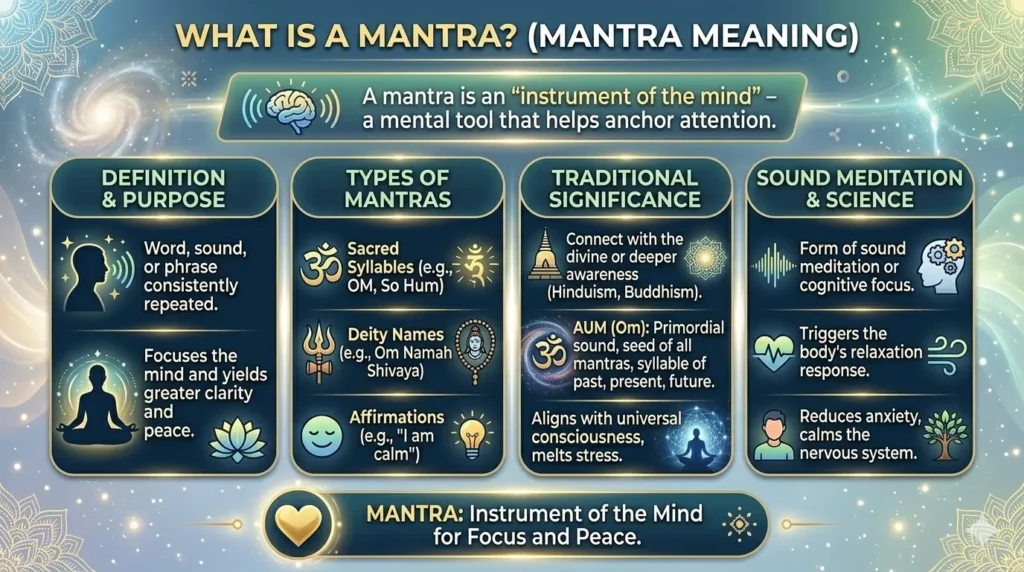
A mantra is a word, sound or phrase that is consciously repeated during meditation or prayer to focus the mind.
As the Sanskrit root indicates, a mantra is an “instrument of the mind” – a mental tool that helps anchor attention. Mantras may be sacred syllables (like Om or So Hum), names of deities (“Om Namah Shivaya”), or affirmations of meaning (“I am calm” in Sanskrit or English).
Chanting or mentally repeating a mantra keeps the mind from wandering, yielding greater clarity and peace .
Traditionally, mantras are associated with spiritual practices. For example, many Hindus and Buddhists use them to connect with the divine or with deeper awareness.
In yoga philosophy, “Om” (AUM) is considered the primordial sound of the universe, the seed of all mantras, “the syllable of the past, present, and future” . Chanting “Om” is said to align us with universal consciousness and melt away worldly stress.
Even outside religion, mantras serve as a form of sound meditation or cognitive focus. Modern science supports this: studies find that repeating a soothing mantra can trigger the body’s relaxation response, reducing anxiety and calming the nervous system
Origins and Meaning
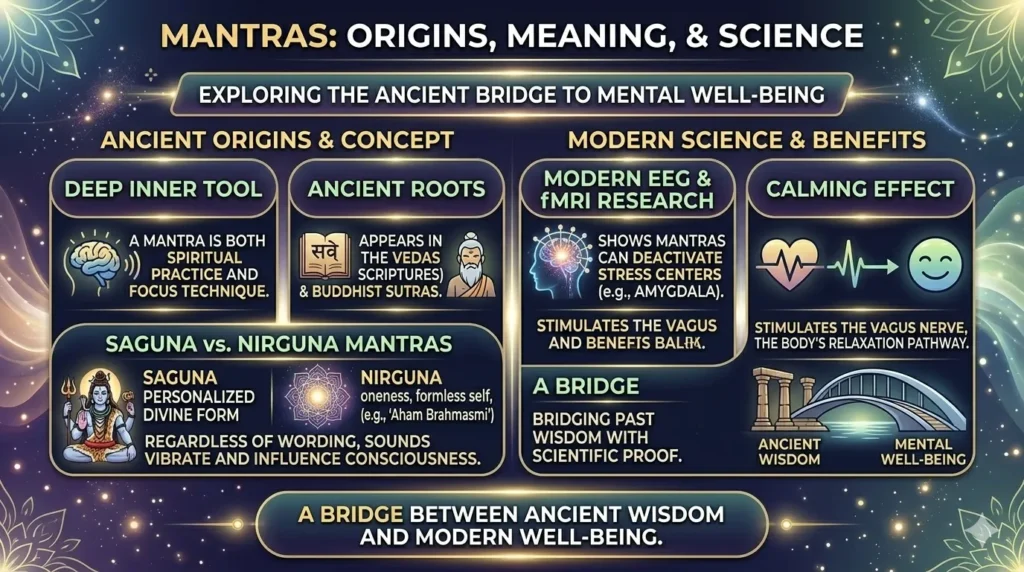
Mantras have ancient roots. The term “mantra” appears in the Vedas (the oldest scriptures of Hinduism) and in Buddhist sutras. Early sages used mantras to encapsulate profound ideas or to entrain the mind on spiritual truths.
Nirgunamantras (such as “Aham Brahmasmi,” meaning “I am the ultimate reality”) point to the formless self or Brahman, reflecting ultimate oneness.
Saguna mantras (like invoking Lord Shiva or Goddess Lakshmi) personalize the divine. Regardless of wording, the vibrational quality of these sounds is believed to influence consciousness.
In fact, modern EEG and fMRI research shows that mantras can deactivate stress centers in the brain (like the amygdala) and stimulate the vagus nerve, the body’s relaxation pathway . In short, a mantra is both a spiritual practice and a focus technique – a bridge between ancient wisdom and mental well-being.
Types of Mantras
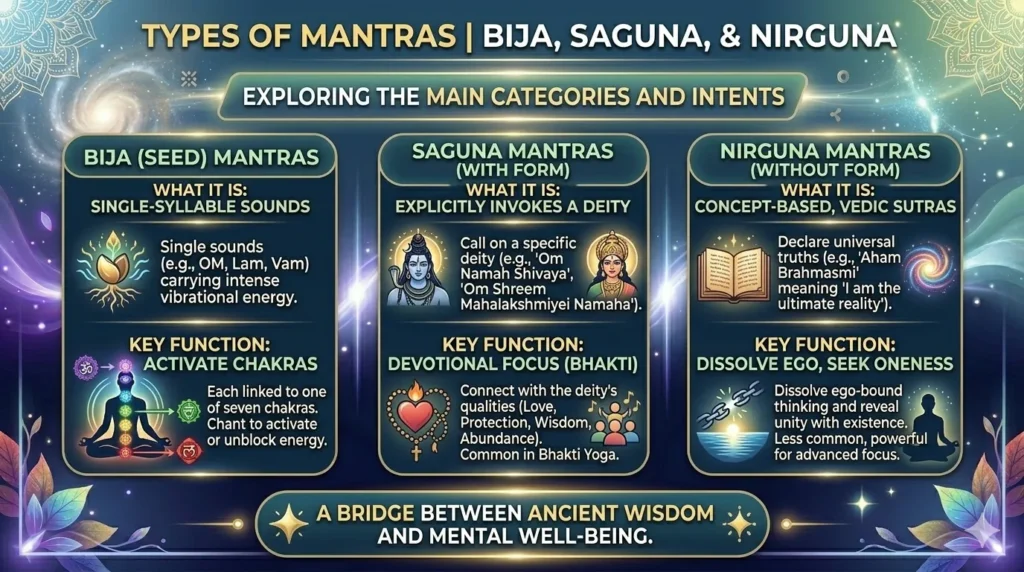
Mantras vary widely in length and intent. The main categories are:
Bīja (Seed) Mantras: Single-syllable sounds (like Om, Lam, Vam) that carry intense vibrational energy. Each seed mantra is linked with one of the seven chakras (energy centers) . For example, “Om” resonates with the crown chakra (top of the head), while “Lam” is tied to the root chakra (base of the spine).
By chanting a bija mantra, practitioners aim to activate or unblock that chakra’s energy . These short seed sounds can stand alone or be combined with longer chants. They are called “seed” mantras because, like a seed, they contain powerful potential.
Saguna Mantras (With Form): These mantras explicitly invoke a deity or form. For example, “Om Namah Shivaya” calls on Shiva’s energy, and “Om Shreem Mahalakshmiyei Namaha” invokes Goddess Lakshmi’s abundance. Saguna mantras are common in devotional (bhakti) yoga.
Chanting a name connects the practitioner with the qualities of that form (love, protection, wisdom, etc.). Even if you’re not Hindu, such mantras can be used as affirmations of those attributes. The rhythm of the chant, combined with the meaning, helps deepen concentration and devotion.
Nirguna Mantras (Without Form): These are concept-based mantras from the Vedas or Upanishads. Instead of naming a god, they declare a universal truth. For example, “Aham Brahmasmi” means “I am (the) Divine.” These abstract mantras are said to dissolve ego-bound thinking and reveal one’s unity with existence. Because they require strong focus, they are less common for beginners but powerful for advanced practitioners who seek a direct sense of oneness.
Benefits of Mantra Chanting
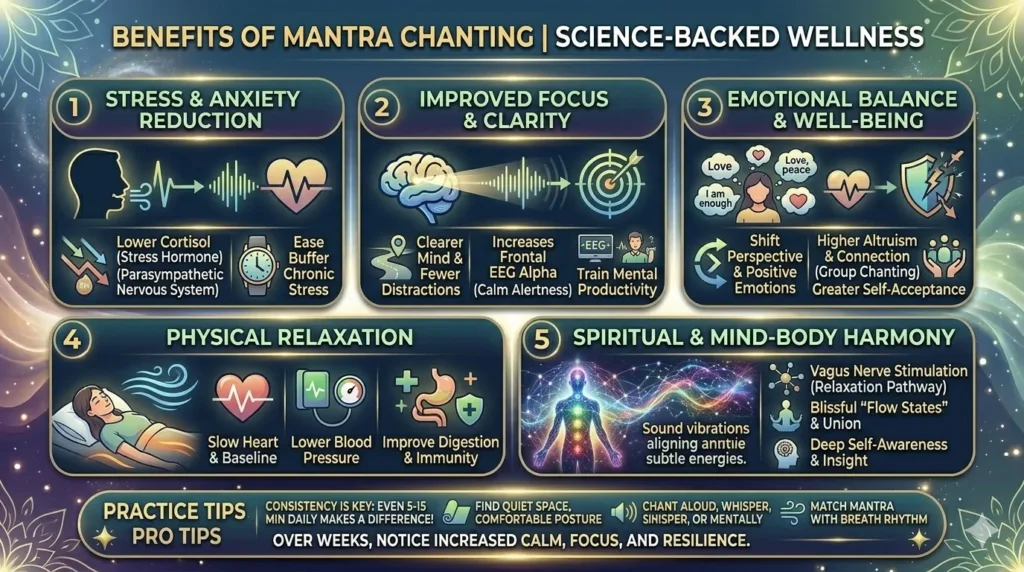
Chanting mantras isn’t just spiritually fulfilling – it also offers real, science-backed wellness benefits. Studies in psychology and neuroscience show that mantra meditation triggers relaxation, clarity and even physiological healing. Key benefits include:
Stress and Anxiety Reduction: The rhythmic repetition of a mantra activates the parasympathetic (rest-and-digest) nervous system. Research shows that even a short session of chanting can significantly lower cortisol (the stress hormone) and ease anxiety .
For instance, a 2023 study found that just 12 minutes of group “Om” chanting (vocally or silently) led to marked drops in cortisol and self-reported anxiety . Mantra meditation also slows down breathing and heart rate to a calm baseline . Over time, these effects buffer chronic stress and improve mood.
Improved Focus and Mental Clarity: A mantra serves as an “anchor” for the wandering mind. By concentrating on a sound, you reduce distractions and mental chatter. Brain scans of meditators show that mantra practice increases frontal alpha waves, associated with calm alertness .
In one study, people practicing mantra-based meditation exhibited greater frontal EEG alpha and fewer signs of cognitive anxiety than those doing relaxation alone . Regular chanting can train the mind to stay present; many practitioners report sharper concentration and productivity off the mat as well.
Emotional Balance and Well-being: Chanting cultivates positive emotions. The simple act of repeating a meaningful phrase (“peace,” “love,” “I am enough,” etc.) can shift perspective and break negative thought loops. Many people feel increased compassion, self-acceptance and inner peace with practice.
Group chanting also fosters social bonding: researchers observed that people who chanted together reported higher altruism and connection afterward . In other words, mantra practice can make you feel more connected – to yourself, to others, and to the world.
Physical Relaxation: On the body level, mantra meditation can physiologically relax you. Chanting often involves slow, deep breathing, which by itself lowers blood pressure and reduces tension. In fact, studies of Om chanting showed improvements in cardiovascular measures: heart rate and blood pressure tended to drop after regular practice .
One review found that loud Om chanting immediately boosts high-frequency heart-rate variability (an indicator of vagal tone) . Another found that just a few minutes of chanting produces warmth and calm in the body . These shifts support better digestion, stronger immunity and overall health in the long run.
Spiritual & Mind-Body Harmony: Many practitioners experience a sense of connection to something larger. Mantras create vibrational resonance throughout the body. Modern neuroimaging suggests that chanting can deactivate stress-related brain regions and stimulate the vagus nerve (a key “relaxation pathway”) .
In effect, sound vibrations align your subtle energies. People often report insights, deeper self-awareness, or blissful “flow states” during extended mantra meditation. In traditional terms, this is union with higher consciousness. Scientifically, it’s a combination of focused attention, rhythmic breathing and positive intention working together to balance mind and body.

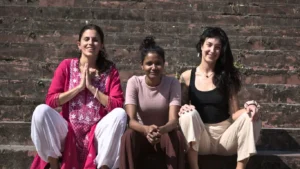
Popular mantras like “Om” or “So Hum” are often chanted during seated meditation practices.
Pro tip: Find a quiet space free from distractions. Sit comfortably (or lie down if needed), with a straight spine. Close your eyes and take a few deep breaths. Then begin chanting your chosen mantra. You can chant aloud, whisper it, or repeat it mentally.
Match the mantra with your breathing rhythm (e.g., one syllable on the inhale, one on the exhale). If your mind wanders, gently bring attention back to the sound. Even a short daily session (5–15 minutes) can make a difference.
Consistency is more important than duration – daily repetition “plants the seed” of peace in your brain . Over weeks, you’ll notice increased calm, focus, and resilience.
How Mantras Work: Sound, Vibration & Intention
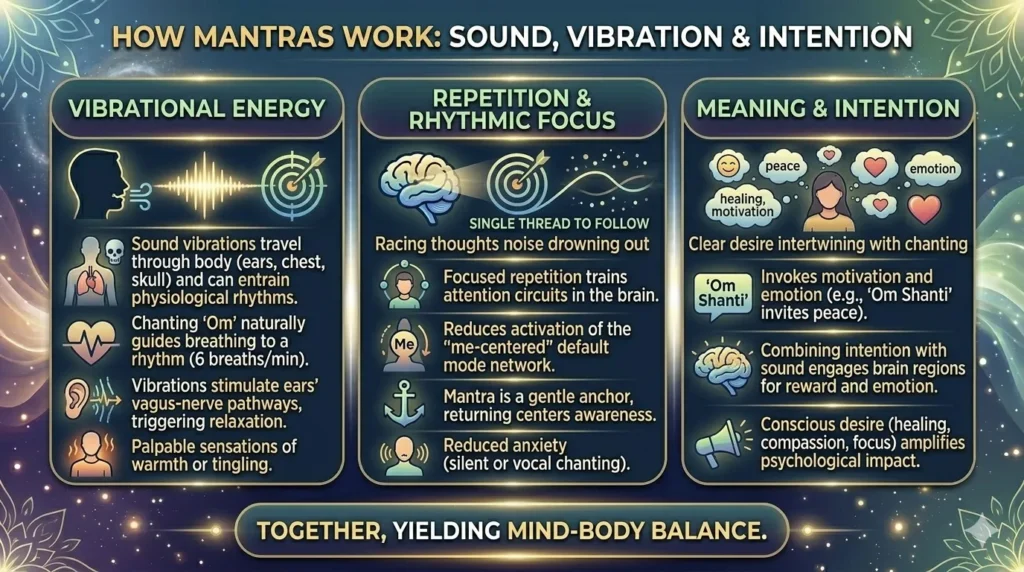
Mantras may seem mystical, but neuroscience offers clues on how they work:
Vibrational Energy: Every mantra has a sound frequency. When you chant, those vibrations travel through your body (ears, chest, skull) and can entrain physiological rhythms.
For example, chanting “Om” at a slow pace naturally guides breathing to about 6 breaths per minute – a known cardioprotective rhythm . Vibrations can also stimulate the ear’s vagus-nerve pathways , triggering the same relaxation effect as controlled breathing or yoga. This is why a simple syllable can produce palpable sensations of warmth or tingling.
Repetition and Rhythmic Focus: Repeating a mantra gives the mind a single thread to follow. The regular cadence drowns out noise from our racing thoughts. Neuroscience studies suggest that such focused repetition trains attention circuits in the brain, reducing activation of the “me-centered” default mode network.
In practice, the mantra becomes a gentle anchor – even if you drift, returning to the chant centers awareness. Over time, this trains a habit of mindfulness. In fact, even silent or vocal chanting has been shown to similarly reduce anxiety , highlighting that rhythm and repetition alone are powerful.
Meaning and Intention: Beyond the sound itself, the meaning or intention behind a mantra matters. A beloved phrase or deity name can invoke motivation and emotion. Saying “Om Shanti” (meaning “peace”) invites that feeling into your psyche.
Studies on meditation suggest that combining intention with sound engages brain regions linked to reward and emotion. In other words, your conscious desire (healing, compassion, focus, etc.) becomes intertwined with the act of chanting. This is why many practitioners set a clear intention before meditating – it amplifies the psychological impact.
Together, these elements explain why mantras can be both deeply spiritual and scientifically effective. The sensory experience of sound harmonizes with psychology of focus and intention, yielding a mind-body balance.
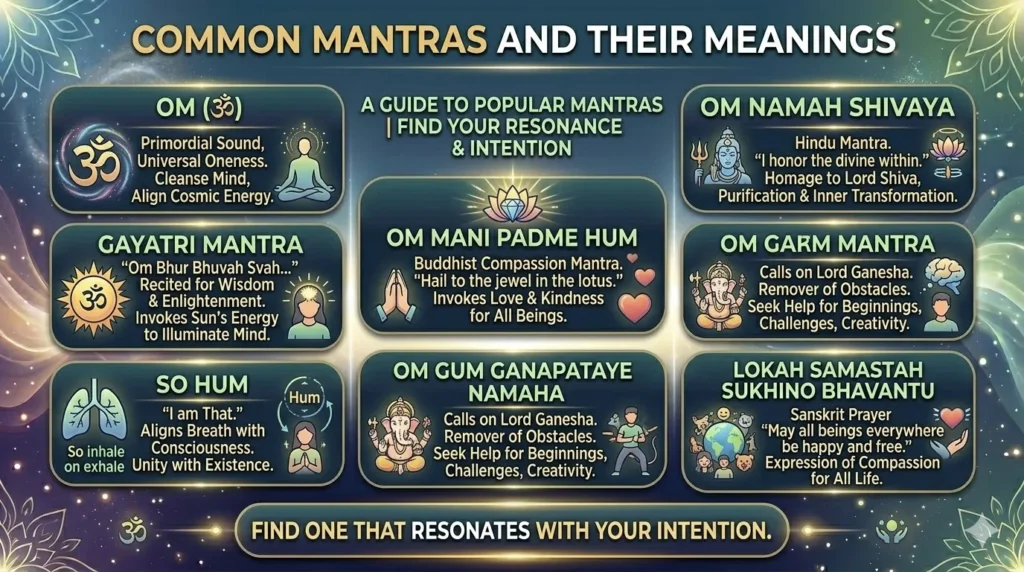
Common Mantras and Their Meanings
Om (ॐ): Known as the primordial sound, Om represents the universal “oneness.” Chanting Om is said to cleanse the mind and align you with cosmic energy. Studies confirm its relaxing effect . (Often used to begin or end yoga and meditation sessions.)
Gayatri Mantra: A Vedic chant beginning “Om Bhur Bhuvah Svah…”, it’s recited for wisdom and enlightenment. It invokes the sun’s energy to illuminate the mind.
Om Mani Padme Hum: A Buddhist mantra meaning “Hail to the jewel in the lotus.” It embodies compassion. Chanting this invokes qualities of love and kindness towards all beings.
Om Namah Shivaya: A Hindu mantra meaning “I honor the divine within.” It pays homage to Lord Shiva and is used for purification and inner transformation.
So Hum: Literally “I am That.” This simple mantra is often used to align breath with consciousness. It reminds the practitioner of their unity with existence. (Mentally say “So” on the inhale and “Hum” on the exhale.)
Om Gum Ganapataye Namaha: A mantra calling on Lord Ganesha, the remover of obstacles. It’s used when seeking help with beginnings, challenges or creativity.
Lokah Samastah Sukhino Bhavantu: A Sanskrit prayer meaning “May all beings everywhere be happy and free.” This mantra expresses compassion for all life. Chanting it cultivates goodwill and a sense of shared humanity.
Each mantra carries its own vibration and meaning. Beginners might start with simple seed sounds (Om, So Hum). Later, you can explore longer chants or create your own affirmations. The key is to find one that resonates with your intention.
Mantra Meditation Practice Tips
Choose Your Mantra: Pick a mantra that feels meaningful to you. Beginners often start with “Om” (for calmness) or “So Hum” (for self-awareness). You can also use a positive phrase (e.g. “I am peace”) in any language. The exact words matter less than your personal connection and intent.
Learn Correct Pronunciation: Especially for Sanskrit mantras, try to learn the traditional pronunciation (via a teacher or audio guide). Proper vowel sounds allow the resonance to fully form. However, don’t worry if you’re not perfect – focus first on intention and focus, then refine pronunciation over time.
Set a Clear Intention: Before starting, decide why you are chanting. It could be for stress relief, focus, healing, or spiritual growth. Holding this intention in mind as you chant enhances the effect, engaging your motivation and emotions in the process.
Posture and Environment: Sit comfortably with a straight spine (you can sit on the floor or in a chair). If possible, designate a quiet sacred space for practice – maybe a corner with cushions or a candle. Eliminating distractions (phone, noise) helps your mind settle.
Breath and Rhythm: Coordinate your chanting with even, deep breaths. For example, inhale as you silently repeat part of the mantra, exhale with another part. Alternatively, chant in a steady rhythm (not too fast) that feels natural. Deep breathing calms the nervous system and makes the chant more meditative.
Duration and Consistency: Start small – even 5 minutes daily can build momentum. The physiological benefits of mantra occur quickly (studies show stress markers drop in a single session) . Gradually increase as you feel comfortable. Ideally, stick to a regular schedule (morning or evening) to turn it into a habit. Consistency is the “secret sauce” for deep results.
Mindfulness of Effects: After a session, notice how you feel. You might be more relaxed, centered, or simply present. Over days and weeks, observe subtle shifts in mood or focus. These signs indicate the practice is working on body and mind.
Frequently Asked Questions
What is a mantra, really?
How long do I need to chant mantra to get benefits?
Does mantra have to be loud, or can it be silent?
Are mantras only for religious people?
What if I pronounce mantra wrong?
How will I know mantra’s working?
Integrating mantras into your daily routine can be a powerful complement to yoga, meditation, and mindfulness. By blending this ancient practice with modern understanding, you tap into a tool that heals on many levels. Try it for yourself – chant, breathe, and feel the vibration. The union of sound and science may just bring you the peace and presence you’ve been seeking.